

Navigating the gateway to any online gaming platform is a critical technical process where security, accessibility, and speed intersect. This whitepaper provides an exhaustive technical analysis of the Mystake login ecosystem, extending far beyond a simple entry point to cover the integrated framework of the Mystake app, authentication layers, and systemic troubleshooting. We will dissect the architecture of access, from credential management and 2FA implementation to solving latency and cache issues, providing a definitive guide for both novice users and technically-inclined players.
Before You Start: System Readiness Checklist
To ensure a frictionless authentication process, verify these pre-conditions. This is the equivalent of a pre-flight check for your gaming session.
- Credential Integrity: Your registered email and password are stored in a secure password manager. Passwords should be unique and complex.
- Device & Network Compliance: The device (PC, smartphone) is not jailbroken/rooted and is connected to a stable, private network. Public Wi-Fi is a security risk.
- Jurisdictional Verification: Your physical location complies with the geolocation policies of Mystake’s licensing jurisdiction (Curaçao eGaming). Use of a VPN for access is strictly prohibited and will trigger a lockout.
- Software Status: Your chosen browser is updated to its latest version, with JavaScript enabled. If using the native Mystake app, ensure it is the official version from the Mystake website or a trusted app repository.
- Account Status: Your account is fully verified (KYC process completed). Unverified accounts may have login or withdrawal functionalities restricted post-login.
The Authentication Protocol: Step-by-Step Login Analysis
The core login flow is a standard HTTPS POST request, but its robustness lies in the backend validation.
- Navigate to the Portal: Access the official Mystake website. The login modal is typically in the top-right header.
- Credential Input: Enter your email (the primary account identifier) and your password. The system is case-sensitive.
- Security Challenge (If enabled): If Two-Factor Authentication (2FA) is active, you will be prompted for a time-based one-time password (TOTP) from your authenticator app (e.g., Google Authenticator, Authy). This step occurs after correct primary credential submission.
- Session Initiation: Upon successful validation, the server establishes a secure session cookie, logging you into your account dashboard. Session timeout periods are set by the system, typically after a period of inactivity.
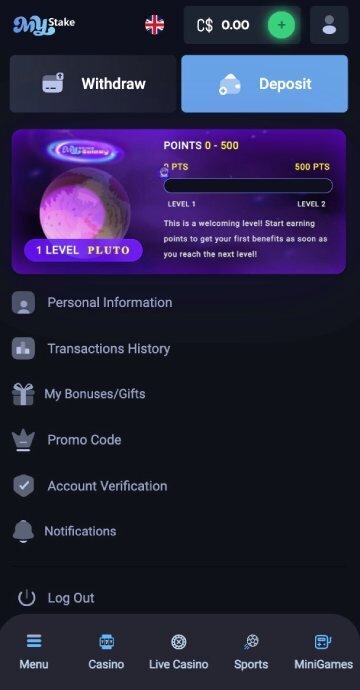
Mystake App Architecture: Installation & Deep Configuration
The Mystake app is a hybrid web-wrapper application, providing a native container for the mobile-optimized website. This architecture allows for rapid feature updates.
- Official Source: The APK (Android) or direct download link (iOS) is available on the Mystake website. Avoid third-party app stores to mitigate the risk of malicious code injection.
- Installation Permissions: On Android, you must enable “Install from Unknown Sources” for the specific browser used to download the APK. This is a standard security gate for non-Play Store apps. The app requests standard permissions for notifications and storage (for caching game data).
- Biometric Integration: Post-initial login, the Mystake app can often leverage your device’s biometric systems (Touch ID, Face ID, fingerprint sensor) for subsequent authentications. This stores an encrypted token locally, bypassing the manual credential entry for faster access.
- Performance Optimization: The app’s performance is directly tied to your device’s RAM and processor. Clearing the app’s cache periodically (via device settings) can resolve graphical glitches or slowdowns in game loading.
| Component | Specification & Protocol | Technical Note |
|---|---|---|
| Login Security | 256-bit SSL Encryption, Optional TOTP 2FA | Base layer is TLS 1.2+. 2FA is highly recommended for all accounts. |
| Session Management | Secure HTTP-only Cookies, Configurable Timeout | Sessions typically expire after 15-30 minutes of inactivity to mitigate session hijacking. |
| App Type | Hybrid (Web-wrapper) for Android & iOS | Small download size (~5-15 MB). Updates are delivered server-side, not via app store. |
| Credential Recovery | Email-based Password Reset Flow | Reset links are time-bound (usually 1 hour). No password hints or security questions are used. |
| Geolocation Check | Passive IP Analysis & Potential GPS Ping (App) | The system continuously verifies location. Discrepancies can trigger a “forced logout.” |
Bonus Strategy & Wagering Mathematics: A Practical Calculation
Logging in is often motivated by accessing bonuses. Understanding the underlying math is crucial. Let’s model a common scenario.
Scenario: You claim a £100 bonus with a 40x wagering requirement (WR) on the bonus amount only. Game contributions: Slots 100%, Table Games 10%, Live Dealer 5%.
Calculation:
- Base Wagering Obligation: £100 (Bonus) x 40 (WR) = £4,000.
- Effective Wagering based on Game Play: If you play exclusively blackjack (contrib. 10%), your wagers are discounted. Every £10 bet contributes £1 to the requirement. Thus, you must bet £40,000 to meet the £4,000 effective requirement (£40,000 * 0.10 = £4,000).
- Optimal Strategy: To minimize the required turnover, play 100% contributing slots. Your required betting volume remains at the base £4,000. This significantly reduces the statistical “house edge” impact on your bonus balance during wagering.
This mathematical framework underscores why simply “logging in and claiming” is insufficient; a strategic approach to fulfilling conditions is required.
Banking Corridor: Linking Login to Financial Operations
Successful authentication grants access to the financial engine. Key integrations include:
- Deposit Correlation: Most deposit methods (e.g., card, e-wallet) do not require re-authentication post-login, as the financial gateway handles that.
- Withdrawal Authentication: This is a critical security checkpoint. Initiating a withdrawal often triggers a secondary verification, such as re-entering your password or confirming via email. This is a deliberate friction point to prevent unauthorized fund removal.
- Transaction History: All financial movements are logged in a read-only section post-login, providing a full audit trail.
Security Architecture & Threat Mitigation
The Mystake login system is designed with layered defenses.
- Brute Force Protection: Multiple failed login attempts will temporarily lock the account, triggering a cool-down period or a mandatory password reset via email.
- Device Fingerprinting: The system may create a hash of your device’s properties (browser type, OS, screen resolution). A significant change can trigger a security alert.
- Encryption at Rest: User passwords are not stored in plaintext. They are hashed and salted using industry-standard algorithms (e.g., bcrypt).
- Player Responsibility: Never share your 2FA codes. Log out from shared devices. Using the “Remember Me” function should be restricted to personal, secure devices only.
Comprehensive Troubleshooting Matrix
When the login sequence fails, systematic diagnosis is required.
| Symptom | Probable Cause | Technical Resolution |
|---|---|---|
| “Invalid Credentials” Error | Incorrect email/password, or caps lock enabled. | Use password manager for accuracy. Initiate “Forgot Password” flow. Manually type password in a text editor to check visibility. |
| Page Not Loading / 404 Error | DNS issues, local ISP block, or outdated browser cache. | Flush DNS cache (`ipconfig /flushdns` on Windows). Try mobile data as alternative network. Clear browser cache and cookies for the site. |
| 2FA Code Not Accepted | Time synchronization drift on your authenticator app. | In your authenticator app (e.g., Google Authenticator), find the option to “Time correction for codes” or “Sync clock.” Re-synchronize. |
| App Crashes on Launch | Corrupted local cache or OS compatibility issue. | Force stop the Mystake app, clear its cache (NOT data), and restart. If persistent, uninstall, reboot device, and reinstall from the official source. |
| Login Loop (Redirects back to login page) | Browser cookie rejection, or conflicting browser extensions. | Disable ad-blockers or privacy extensions for the site. Ensure cookies are enabled. Try an incognito/private browser window. |
| “Account Disabled” Message | Security flag, KYC failure, or self-exclusion. | This requires direct intervention. You must contact Mystake customer support via the registered email for investigation. |
Extended Technical FAQ
Q1: I lost access to my 2FA device. How can I log in to Mystake?
A: You must contact customer support directly. Be prepared to verify your identity thoroughly (provide registered email, copies of ID, recent transaction details). They will disable 2FA on your account, allowing you to log in with just your password, after which you should re-enable 2FA with a new device.
Q2: Is the Mystake app safer than the browser for logging in?
A: Both use identical encryption. The Mystake app can offer an additional layer of security if you utilize its biometric login, as it prevents keyloggers that might be present on a desktop system. However, the app’s security is only as good as the device it’s installed on.
Q3: Why does the site sometimes ask for my password again before a withdrawal, even though I’m logged in?
A: This is a deliberate security protocol called “step-up authentication.” It adds a critical friction point for sensitive financial transactions, ensuring that even if someone gained brief access to your active session, they could not immediately withdraw funds.
Q4: Can I be logged into Mystake from multiple devices simultaneously?
A: Typically, yes. However, policies vary. Some actions (like active gameplay) may be restricted to one device at a time. Simultaneous logins from geographically impossible locations will trigger a security alert and may force logout on all sessions.
Q5: How is my login session data stored and used?
A: Upon login, the server issues a unique session ID stored in an encrypted cookie on your device. This ID is matched to your account on the server for the session’s duration. It tracks activity for security, timeout, and responsible gaming features but should not contain sensitive personal data.
Q6: What is the specific process for the “Forgot Password” function?
A: 1) Click “Forgot Password.” 2) Enter your registered email. 3) Receive a time-limited (e.g., 60-minute) password reset link. 4) Clicking the link takes you to a secure page to set a new password. The old password is immediately invalidated. If you don’t receive the email, check your spam folder and ensure the request email matches your registered address exactly.
Q7: Does using the Mystake app consume more data than the mobile browser?
A: Generally, the app can be more data-efficient for repeated use. It caches static elements (images, framework code). The mobile browser loads these elements fresh more often. However, prolonged live dealer gameplay will consume significant data on either platform due to the video stream.
Q8: I am getting a “Secure Connection Failed” error. What does this mean?
A: This is a browser-level SSL/TLS handshake failure. Causes include: your system clock being incorrect, an overzealous firewall/antivirus interfering, or an extremely rare case of the site’s SSL certificate being revoked or expired. Check your system time/date, temporarily disable security software, or try a different network.
Q9: What is the difference between “Log Out” and simply closing the browser tab?
A> Closing the tab does not actively terminate your server-side session immediately; it may remain active until its timeout. “Logging Out” sends a command to the server to explicitly destroy the session, providing immediate security closure. Always use the Log Out button on shared or public devices.
Q10: Are my login details shared with game providers when I play?
A> No. Game providers (NetEnt, Pragmatic Play, etc.) receive an anonymous token or session ID generated by the Mystake platform. Your personal credentials and account details are never exposed to the third-party game server.
Conclusion: The Gateway as a System
The Mystake login process is not a mere button click but a sophisticated system integrating cybersecurity, user experience, and regulatory compliance. Mastering it—from the initial credential entry and optional 2FA fortification to navigating the Mystake app and resolving deep technical faults—empowers you to access the platform’s offerings with maximum security and minimum disruption. This guide provides the architectural blueprint and diagnostic tools necessary to ensure your gateway remains secure, functional, and under your complete control. Remember, in iGaming, the first and most important win is securing your own digital front door.
